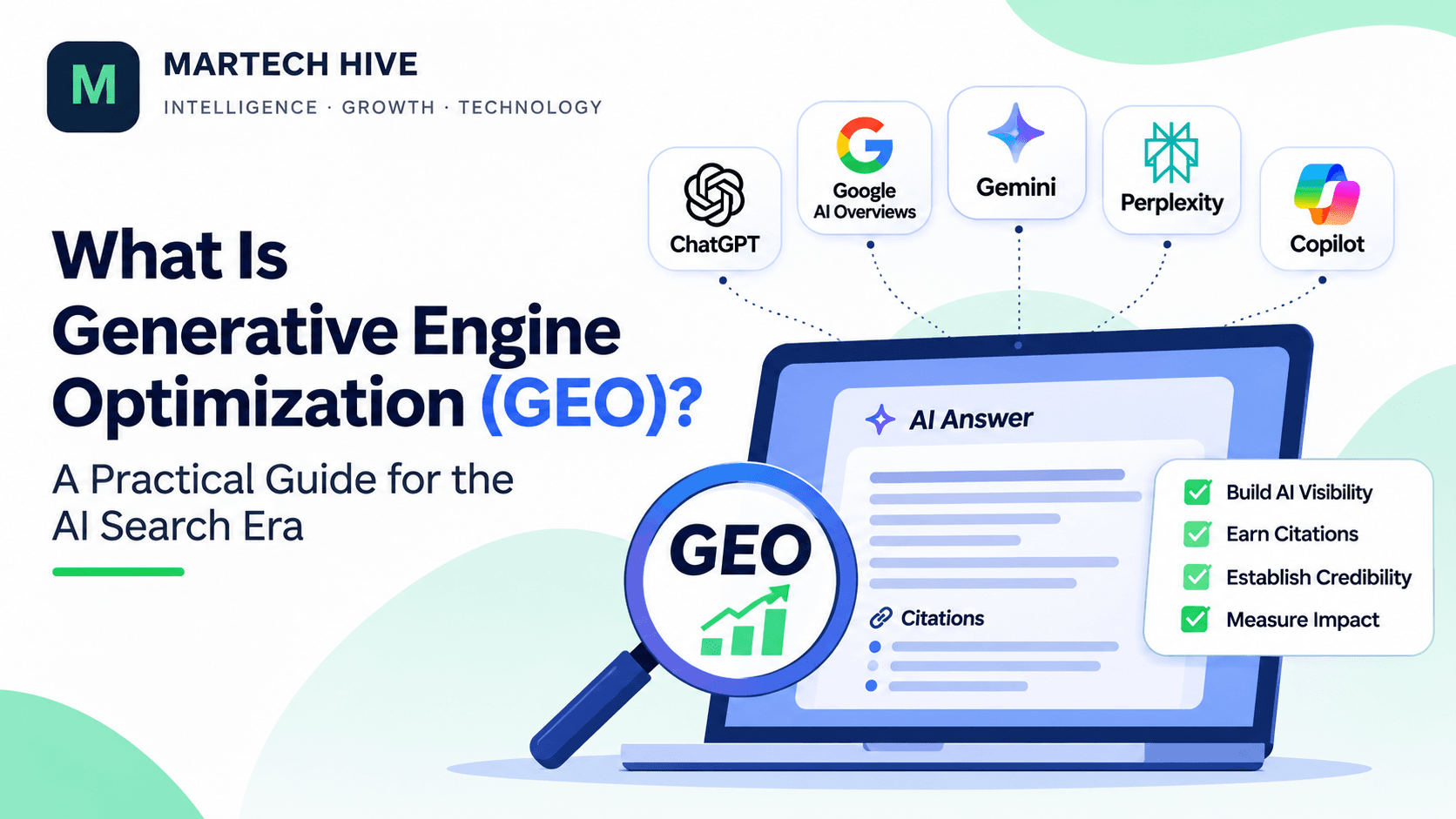
People no longer rely on Google alone to research topics, compare products, or shortlist vendors. Increasingly, they ask AI platforms such as ChatGPT, Google AI Mode, Gemini, Perplexity, and Microsoft Copilot, and receive a synthesized answer with links to supporting sources instead of a page of blue links.
That creates a new question for businesses: how do you stay visible when an AI system writes the answer?
Generative Engine Optimization (GEO) is the emerging response. This guide explains what GEO is, how AI search retrieves and cites information, how GEO differs from SEO and Answer Engine Optimization (AEO), which tactics have real support, and which are hype. We checked the claims against current guidance from Google, OpenAI, and Microsoft and against recent independent research. Sources are listed at the end.
The short version: GEO is mostly strong SEO with a few additions: original content, well-supported claims, accurate information across the web, crawler access, and careful measurement. There is no secret formula, and nobody can guarantee an AI mention.
What Is Generative Engine Optimization (GEO)?
GEO is the practice of improving how a brand and its content are discovered, represented, and cited in answers generated by AI search engines and assistants. These include:
The term gained traction through a 2024 research paper by academics from Princeton, IIT Delhi, and other institutions, presented at the ACM KDD conference, which tested how different content changes affect visibility in generative engines.
Traditional SEO aims to earn visibility in search engine results pages. GEO aims to make a brand’s information useful, accessible, and credible enough that AI systems retrieve it, describe it accurately, and cite it.
For example, imagine someone asks ChatGPT: “What are the best marketing automation platforms for a growing B2B company?” The AI might recommend several platforms, compare their strengths, and link to supporting sources. A marketing automation vendor wants to be included in that answer, described correctly, and ideally linked to a credible source. That is the opportunity GEO addresses.
In simple terms: SEO helps people find your website in search results. GEO helps your brand get found, understood, and referenced inside AI-generated answers.
Two caveats are worth stating up front:
- GEO guarantees nothing. Responses vary by platform, query, available sources, and context. Even the same prompt, run repeatedly on the same platform, usually produces different brand lists (more on this in the measurement section).
- Google does not treat GEO as a separate discipline. Its official guidance says that, from Google Search’s perspective, optimizing for generative AI search is optimizing for the search experience, which is still SEO. A useful way to hold both views: GEO is a lens for AI-specific visibility and measurement, built on SEO foundations rather than replacing them.
Why Is GEO Becoming Important?
Generative AI is changing how people research and buy. In June 2026, Google reported that AI Overviews has more than 2.5 billion monthly users and AI Mode more than one billion. Alongside them, standalone assistants are becoming a normal starting point for research.
The journey changes accordingly. Someone researching software used to open several websites, compare features, and read reviews. Now they can ask an assistant to shortlist products, compare pricing, and recommend one. Three common scenarios:
- B2B software research: A business owner asks for a comparison of CRM platforms for a small sales team. The answer may draw on vendor sites, review platforms, and industry publications.
- Consumer product research: A shopper asks which laptop is best for video editing within a budget. The answer may combine specifications, reviews, and product pages.
- Professional services discovery: A company asks for digital marketing agencies that specialize in healthcare. The answer may use agency websites, directories, case studies, and third-party articles.
In each case, a brand can enter the buyer’s consideration set before the buyer visits its website.
From search rankings to AI visibility
Traditional search | AI-powered search |
|---|---|
Displays ranked web pages | Generates synthesized answers |
Users compare multiple links | Users receive summarized information |
Rankings are a core visibility metric | Mentions and citations become additional signals |
Click-through traffic is central | Visibility can occur without a website visit |
Keywords and search intent guide optimization | Context, relevance, credibility, and retrievability also matter |
A reality check on traffic
AI visibility does not yet translate into large traffic volumes for most sites. SE Ranking’s 2026 analysis found that AI platforms sent about 0.32% of all website traffic, up from 0.02% in 2024, while organic search still accounted for roughly 43%. Growth is real, but Google remains a far bigger source of visits. That is exactly why GEO should be measured by mentions, citations, and accuracy as well as clicks.
Traditional search is not disappearing. Both experiences coexist, and the strategic goal is visibility across both.
How Does Generative Engine Optimization Work?
Many AI search systems use Retrieval-Augmented Generation (RAG). Instead of relying only on what a model learned in training, the system retrieves relevant pages from an index or the live web and uses them to ground its answer. Google describes its own AI features in these terms: RAG pulls pages from Google’s core Search index and ranking systems, and the model then generates an answer with links to supporting pages.
Google also describes a technique called query fan-out: the system issues several related searches across subtopics rather than relying on the user’s exact wording.
A simplified workflow looks like this:
- The user submits a query. For example: “Which customer data platforms suit mid-sized B2B companies?”
- The system interprets and expands the query. It may break the question into related searches such as CDP features, CRM integrations, pricing, implementation effort, and mid-market versus enterprise requirements.
- Information is retrieved. Sources can include company websites, industry publications, research reports, product documentation, review sites, and case studies, depending on the platform.
- Sources are evaluated and selected. Relevance, content quality, freshness, source credibility, and contextual fit can all matter, though the exact mechanisms differ by platform.
- The model writes the answer. It may summarize sources, compare options, and include citations where the product supports them.
- A brand is mentioned or cited. If your content contributed relevant information, you may be named or linked, sometimes without any click.
Simplified view: User query → query expansion → retrieval → source selection → generated answer → brand mention or citation.
There is no single universal AI ranking algorithm. Google’s AI features, ChatGPT search, Perplexity, and Copilot each use their own retrieval systems. What they share is a dependence on content that can be found, understood, and trusted.
GEO vs SEO vs AEO: What Is the Difference?
These disciplines overlap heavily but are not identical.
SEO (Search Engine Optimization) improves organic visibility in search engines such as Google and Bing through keyword research, technical SEO, on-page optimization, content, internal linking, backlinks, and site performance. The goal is relevant organic visits.
AEO (Answer Engine Optimization) structures information so answer-oriented platforms can surface direct answers. Typical work includes answering specific questions clearly, building useful FAQs, using descriptive headings, and writing concise explanations. The term has long been used for featured snippets and voice search, and now for AI answers too.
GEO (Generative Engine Optimization) focuses on the likelihood that a brand or its information is retrieved, represented, and cited in generative AI responses. It includes building topical authority, publishing original research, keeping information accurate and accessible, earning credible third-party mentions, and monitoring how AI platforms describe the brand.
Area | SEO | AEO | GEO |
|---|---|---|---|
Primary focus | Search visibility | Direct answers | AI-generated responses |
Main environment | Search engines | Answer engines | Generative AI platforms |
Typical outcome | Rankings and clicks | Answer visibility | Mentions and citations |
Content approach | Relevant, useful content | Clear question-and-answer structure | Credible, distinctive, retrievable information |
Measurement | Rankings, clicks, traffic | Answer appearances | Visibility rate, citations, accuracy, referrals |
A well-structured, authoritative, original article can support all three.
10 Practical GEO Strategies
GEO is still evolving, and no formula guarantees a mention. These ten areas are the most defensible priorities.
1. Create original, non-commodity content
AI systems can already generate generic summaries. Another article that repeats what hundreds of sites say gives them no reason to cite you. Google’s own guidance makes the same point: unique, experience-based content is likely to matter more than any other tactic.
Compare a commodity title with a non-commodity one. Instead of “Benefits of Marketing Automation,” publish “Marketing Automation Adoption in B2B Companies: Trends, Use Cases and Implementation Challenges,” backed by:
- Original research or survey data
- Industry statistics with sources
- Expert commentary
- Real implementation examples and first-hand observations
Original research is one of the strongest differentiators. A survey such as “State of Marketing Automation Adoption Among Indian B2B Businesses” could cover CRM integration challenges, lead management practices, martech budgets, AI adoption, and attribution. Publish the methodology, sample size, survey period, and limitations so others can reference it with confidence. Such a report also serves SEO and PR.
Where it helps readers, support text with relevant images, charts, and video, which AI search features can also surface.
2. Back your claims with evidence
The Princeton-led GEO study tested nine content changes across 10,000 queries. Adding statistics, citations to credible sources, and quotations from relevant experts raised visibility in generative engine answers by up to roughly 40% in the researchers’ benchmark, while keyword stuffing did not help. Treat this as encouraging rather than conclusive: it was a controlled study with a subset tested on Perplexity, and the results do not necessarily transfer to Google or ChatGPT.
The practical takeaway is simply good editorial practice: state specific, verifiable facts, name the source, attribute expert views, and avoid vague claims.
3. Build topical authority, without mass-producing pages
One article rarely establishes expertise. Develop interconnected content around your core subjects. For marketing automation, a cluster might include:
- What Is Marketing Automation?
- Best Marketing Automation Platforms
- Marketing Automation Workflows
- Lead Scoring and Lead Nurturing
- Marketing Automation for B2B
- Marketing Automation Implementation Guide
Link these pieces with relevant internal links so readers and search systems can see how they relate.
One warning: do not create a separate thin page for every possible query variation or fan-out query. Google states that doing this mainly to manipulate rankings or AI responses violates its scaled content abuse policy, and that more pages do not make a site better. Depth beats volume.
4. Write for clarity, not for machines
Clear structure helps readers and retrieval systems alike. Use descriptive H2 and H3 headings, focused paragraphs, clear definitions, relevant examples, comparison tables, and descriptive image captions.
- Weak heading: Why It Matters
- Better heading: Why Customer Data Integration Matters for B2B Marketing
However, there is no need to chop content into tiny fragments or rewrite everything in a special style for AI. Google says its systems understand nuance and synonyms, and that there is no ideal page length. Write for your audience first.
5. Strengthen your brand’s footprint across the web
Your website is only part of your presence. AI answers can draw on industry publications, documentation, directories, review platforms, forums, and videos. Build a consistent, accurate footprint through:
- Contributions to relevant industry publications
- Genuine customer reviews
- Professional directories and credible partner sites
- Interviews, original research, and reports
Keep company names, service descriptions, product details, and locations consistent everywhere. For local businesses and online retailers, tools such as Google Business Profile and Google Merchant Center help keep information accurate in Google’s AI responses and other results.
Avoid buying artificial mentions or publishing low-quality guest posts to manufacture authority. Google notes that seeking inauthentic mentions is not as effective as it seems, and its spam systems are built to counter it.
6. Use structured data appropriately
Structured data helps search engines interpret a page. Relevant Schema.org types include Organization, Article, Product, SoftwareApplication, BreadcrumbList, and Person. Organization markup can communicate a company’s name, website, and logo; Article markup can describe the author, headline, and dates.
The markup must match visible page content. And keep expectations realistic: Google says no special schema is needed for its generative AI features, and structured data is not a guaranteed route to AI mentions. It remains worthwhile for rich results and clarity, but do not over-invest in it for GEO.
7. Make your content technically accessible
Content that systems cannot reach cannot be cited. Review:
- robots.txt rules
- An accurate XML sitemap
- Important content delivered as HTML text
- Broken internal links and canonical URLs
- HTTPS
- Accidental noindex directives
- CDN and firewall rules that might block legitimate crawlers
For Google, a page must be indexed and eligible to appear in Search with a snippet to be shown as a supporting link in AI Overviews or AI Mode, with no additional technical requirements. Google has also begun testing a Search Console control that lets site owners decide whether their content appears in, and helps ground, its generative AI features, so check whether it is available for your property.
For ChatGPT, OpenAI documents three separate user agents:
- OAI-SearchBot supports ChatGPT’s search features. Sites that opt out will not be shown in ChatGPT search answers, though they can still appear as navigational links. OpenAI recommends allowing it in robots.txt and allowing its published IP ranges.
- GPTBot crawls content that may be used to train OpenAI’s generative AI foundation models. Disallowing it signals that your content should not be used for training.
- ChatGPT-User handles actions initiated by a user inside ChatGPT. Because a person triggers it, robots.txt rules may not apply, and it is not used to decide what appears in search.
These are independent controls, so decide deliberately. OpenAI says robots.txt changes can take about 24 hours to take effect for search.
8. Show who is behind your content
Trust matters to people and to the systems that rank sources. Make authorship and standards visible: author bios, relevant professional experience, editorial standards, research methodology, references to authoritative sources, and expert interviews. An article on enterprise CRM implementation is more credible when written or reviewed by someone who has implemented one. Never invent credentials.
9. Keep information accurate and current
AI systems may retrieve older pages, so outdated pricing, discontinued products, stale statistics, and obsolete instructions can damage trust. Set up a maintenance routine:
- Identify pages with time-sensitive information.
- Review product details and statistics.
- Verify external references.
- Update outdated screenshots and examples.
- Record meaningful changes.
- Show accurate publication and modification dates.
Do not change publication dates just to make old content look fresh.
10. Monitor how AI platforms represent you, the right way
You cannot improve what you do not measure, but AI answers are noisy, so the method matters. Build a set of prompts based on your customers’ real questions, for example:
- What are the best marketing automation platforms for B2B companies?
- Which digital marketing agencies specialize in healthcare?
- What are the leading customer data platforms?
- How can a business improve its AI search visibility?
Run each prompt several times on each platform, and record whether your brand appears, whether your site is cited, which competitors and sources show up, and whether the description is accurate. Repeat on a schedule. The next two sections cover tools and metrics.
GEO Tools: Platforms to Monitor AI Visibility
Start with the free, first-party options, then consider paid tools.
Free, first-party reporting
- Google Search Console now includes generative AI performance reports showing impressions for your pages in AI Overviews, AI Mode, and Discover’s AI features, by page, country, device, and date. Rollout and availability can vary, so check your property.
- Bing Webmaster Tools offers an AI Performance report (public preview since February 2026) showing citations in Microsoft Copilot, Bing AI summaries, and select partner integrations, including cited pages and grounding queries. Microsoft later added intent, topic, and citation-share views in preview. It does not cover ChatGPT and does not show clicks.
Paid monitoring platforms (features, coverage, and pricing change quickly)
- Semrush offers an AI Visibility Toolkit alongside its SEO suite, so teams can view classic and AI visibility together. semrush.com
- Ahrefs now includes Brand Radar for tracking brand visibility across AI platforms, in addition to its backlink and keyword tools. ahrefs.com
- Profound focuses on AI search visibility and brand intelligence, including the sources behind AI answers. tryprofound.com
- Peec AI tracks brand mentions, citations, and competitor visibility, with strong source-level detail. peec.ai
- Otterly.AI provides AI search monitoring and visibility tracking, often positioned as a lower-cost entry point. otterly.ai
Choose carefully. Google warns that no third-party tool has access to its internal ranking or AI systems, so be wary of tools that claim otherwise. Research from SparkToro and Gumshoe.ai also suggests that “ranking position in AI answers” is not a stable metric. Prefer tools that report visibility rates over many runs, show their methodology, and let you export raw data. Test on a free trial before committing budget.
How to Measure GEO Performance
SEO has established metrics. GEO needs additional ones, tracked separately and consistently.
Why single tests mislead
In a January 2026 study, SparkToro and Gumshoe.ai had 600 volunteers run 12 prompts across ChatGPT, Claude, and Google’s AI nearly 3,000 times. The chance of seeing the same brand list twice was under 1 in 100, and the same list in the same order roughly 1 in 1,000. Brand lists also varied in length. However, how often a given brand appeared across many runs was far more consistent than its position. (Note: the study’s co-author runs an AI tracking startup.)
The lesson: never judge your visibility from one response. Measure frequency across repeated runs, and ignore claims about exact “rank” in AI answers.
The metrics
- AI visibility rate (brand mentions). In what percentage of runs for a fixed set of prompts and platforms does your brand appear? This is more reliable than position.
- AI citation frequency. How often do answers link to your site as a source? A brand can be named without being cited.
- Share of AI Voice. Your brand’s visibility compared with competitors across a defined query set. A simple version: your brand mentions ÷ total mentions across tracked brands × 100. If you receive 20 of 100 mentions, your share is 20%. This is a directional measure, not an industry standard, so fix your prompt set, platforms, run counts, and counting rules and keep them unchanged.
- AI referral traffic. Look for sessions from sources such as chatgpt.com, perplexity.ai, gemini.google.com, copilot.microsoft.com, and claude.ai in GA4 or your analytics platform. Note that Google counts clicks from AI Overviews and AI Mode within overall Search traffic, so use Search Console’s generative AI reports for those rather than expecting a separate referral line. Many AI-assisted visits also arrive later through direct or branded search, so referral data understates influence.
- AI-influenced conversions. Track demo requests, form submissions, newsletter sign-ups, product enquiries, and purchases from AI referrals. Do not credit AI for every conversion just because a buyer once saw your brand in an answer. Combine referral data, attribution reports, and customer interviews (“how did you first hear about us?”).
- Brand accuracy. Visibility is not always positive. AI platforms may describe products incorrectly, show outdated pricing, or confuse your company with another. Track accuracy of company details, products, pricing, differentiators, and geographic availability as a brand-protection metric.
A 90-Day GEO Roadmap
You do not need to rebuild your strategy to start. A structured 90 days gives you a baseline and a first round of improvements.
Days 1–30: Audit and baseline
- Identify 5–10 competitors and 20–30 customer prompts.
- Run each prompt several times across ChatGPT, Gemini, Perplexity, and Copilot, and record visibility rate and citations.
- Set up Search Console and Bing Webmaster Tools and review their AI reports.
- Audit technical SEO, crawlability, and robots.txt rules for relevant crawlers.
- Review your highest-value existing content for accuracy and gaps.
Output: an AI visibility baseline and a technical audit.
Days 31–60: Improve content and authority
- Update key articles with sourced statistics, expert input, and fresh examples.
- Publish original research or expert-led content.
- Build topic clusters and improve internal linking.
- Strengthen author pages and editorial information.
- Check company details across directories and review sites.
- Validate structured data.
Output: stronger content assets and a more consistent web presence.
Days 61–90: Measure and optimize
- Repeat the original prompt tests with the same method.
- Compare visibility rate, citations, and competitor presence.
- Review AI referral traffic and conversions in GA4, and the Search Console and Bing AI reports.
- Note which external sources AI answers cite most often, and consider how to earn legitimate coverage there.
- Update content based on gaps.
Output: a GEO performance report and a prioritized plan.
Common GEO Myths
Myth 1: GEO replaces SEO. Google says its generative AI features are rooted in its core ranking and quality systems, so SEO fundamentals still apply. Bing and OpenAI likewise rely on crawlable, indexable pages.
Myth 2: An llms.txt file guarantees AI visibility. Google states that it does not use llms.txt or similar files, and that creating them neither helps nor harms visibility in Google Search. You may maintain one for other services that read it, but do not expect it to drive citations.
Myth 3: More keywords mean more AI citations. Unnatural repetition does not build authority. The Princeton-led study found keyword stuffing did not help. Focus on relevance, clarity, and substance.
Myth 4: Schema markup guarantees AI recommendations. Structured data helps communicate information but does not guarantee a mention, and Google says no special markup is required.
Myth 5: Content must be “chunked” for AI. Google says there is no requirement to break content into tiny pieces. Organize for readers.
Myth 6: You can track your exact rank in AI answers. Repeat-run research shows that lists and ordering change constantly. Track visibility rates instead.
Myth 7: Every AI mention produces website traffic. AI visibility can influence awareness and consideration without a visit, and AI referrals remain a small share of total traffic for most sites.
The Future of GEO: Where Is AI Search Heading?
1. AI agents and conversational discovery
Assistants are moving from answering questions to researching, comparing, and completing multi-step tasks. Google’s guidance already points site owners to agent-friendly design practices and to emerging commerce protocols. Accurate product data and clear, accessible pages will matter more as agents act on people’s behalf.
2. First-party information becomes more valuable
Businesses that maintain accurate documentation, original research, pricing, and customer resources give AI systems better material to work with.
3. Better measurement
First-party reporting from Google and Microsoft is arriving, and third-party tools are maturing. Expect more focus on citation quality, brand representation, competitive visibility, and AI-referred conversions, along with more scrutiny of methodology.
4. SEO and GEO converge
Rather than running separate strategies, build one integrated visibility approach: technical SEO, high-quality content, digital PR, brand authority, accurate structured information, and analytics.
Frequently Asked Questions About GEO
What does GEO stand for in digital marketing?
Generative Engine Optimization. It refers to strategies for improving a brand’s visibility, representation, and citation in AI-generated responses.
Is GEO the same as SEO?
Not exactly. SEO focuses on organic visibility in search engines; GEO focuses on visibility in generative AI answers. They share foundations: content quality, technical accessibility, relevance, and authority. Google considers optimizing for its AI features to be part of SEO.
How do I optimize my website for ChatGPT?
Make sure important pages are public, crawlable, useful, and accurate. If you want to be eligible for ChatGPT search, allow OAI-SearchBot in robots.txt and check that your CDN or firewall does not block it. Publish original content, support it with evidence, and build credible references to your brand. Allow about 24 hours for robots.txt changes to take effect.
Does Google support GEO?
Google does not require a separate GEO process for AI Overviews or AI Mode. Its guidance emphasizes established SEO fundamentals, helpful and original content, crawlability, and good page experience.
Do I need an llms.txt file?
Not for Google, which ignores such files. Creating one is harmless and may be used by some other services, but it is not a proven visibility lever.
Is GEO important for small businesses?
Yes. Small businesses can make their expertise, services, locations, and customer information easier to find. A narrow focus on a specific niche is often more practical than competing on broad topics.
How long does GEO take to show results?
There is no guaranteed timeline. Results depend on crawling, indexing, source selection, platform behavior, competition, and content quality. Track trends over months rather than expecting immediate mentions.
What is the difference between GEO and AEO?
AEO aims to make content suitable for direct answers; GEO covers visibility and representation more broadly within generative AI responses. The practices overlap heavily.
Is GEO worth investing in?
If your customers use AI tools to research products and services, it is worth testing. Start with a baseline audit and practical content improvements before paying for expensive monitoring platforms.
Conclusion: Build Visibility Beyond Traditional Search
Search is no longer just a list of web pages. People increasingly use AI to discover brands, understand complex subjects, compare options, and make decisions, so visibility has to be built across a broader ecosystem.
GEO offers a framework for that shift: create useful and original information, support it with evidence, establish credible expertise, keep your content technically accessible, maintain an accurate presence across the web, and measure how AI platforms represent you, using repeated tests rather than one-off screenshots.
GEO should not become a collection of shortcuts. The strongest long-term strategy is to be a brand whose information is worth discovering, referencing, and trusting.
The future of search visibility will not be defined only by where your website ranks. It will also be shaped by how accurately and consistently your brand appears when people ask AI for answers.
At Martech Hive, we will keep exploring how AI, marketing technology, data, and automation are reshaping the way businesses attract and engage customers.
Explore more MarTech insights at Martech Hive.
Sources
- Google Search Central, Optimizing your website for generative AI features on Google Search (updated July 2026)
- Google Search Central, AI features and your website
- Google, New opportunities, control and insights for website owners (June 2026)
- Google Search Central Blog, Introducing Search Generative AI performance reports in Search Console (June 2026)
- OpenAI, Overview of OpenAI crawlers
- Microsoft, Introducing AI Performance in Bing Webmaster Tools (February 2026) and New AI Visibility Insights in Bing Webmaster Tools (June 2026)
- Aggarwal et al., GEO: Generative Engine Optimization, KDD 2024; context from Search Engine Land
- SparkToro and Gumshoe.ai study, as reported by Search Engine Journal (January 2026)
- SE Ranking, AI traffic grew 16x from 2024 to 2026 (June 2026)