Introduction: More marketing tools do not always mean better marketing
Think about a typical marketing team. The website runs on one platform. Campaigns are managed somewhere else. Customer information lives in a CRM. Email automation has its own system, analytics sits in another dashboard, and advertising performance is tracked across multiple accounts.
Each platform does its job. But getting them to work together is often a different story.
A marketing manager might spend hours comparing website enquiries with CRM records, checking campaign performance across dashboards or trying to understand why a lead generated through a campaign never reached the sales team.
This is a familiar problem in many organizations. Marketing technology has advanced considerably, but the way businesses connect and use these tools has not always kept pace.
Artificial intelligence is adding another dimension. It can help teams research faster, analyze customer behaviour, personalize communication and automate repetitive work. But AI alone will not fix disconnected systems or poor-quality data.
Instead of asking which new marketing tool to buy, businesses should ask a more useful question: how can we make our marketing systems work together to produce better results? That is the foundation of a modern MarTech stack.
1. Understanding the modern MarTech stack
A MarTech stack is the collection of technologies a business uses to manage its marketing activities. It may include a website platform, CRM, marketing automation, advertising tools, analytics software and customer data systems.
What makes a modern stack different is how these technologies are connected.
Consider a B2B company trying to generate enquiries through its website. A visitor discovers the company through Google, reads a service page, downloads a guide and eventually submits an enquiry. Ideally, that journey should be visible across the relevant marketing and sales platforms.
The marketing team should understand where the visitor came from, what they engaged with and whether the enquiry became a qualified opportunity. Achieving this requires several technology layers working together.
Customer data and intelligence
Every meaningful marketing decision starts with understanding the customer. Businesses collect information through websites, forms, advertising campaigns, email interactions, sales conversations and customer service systems.
The challenge is that this information is rarely available in one place. Customer data platforms, data warehouses and integration tools can help bring information together, improve consistency and make it more useful.
The objective is not to collect as much data as possible. It is to make sure the right information is available when marketing and sales teams need it.
CRM and sales platforms
CRM is one of the most important components of a B2B MarTech ecosystem. Platforms such as Salesforce and HubSpot help businesses manage prospects, customer relationships, sales activities and opportunities.
A CRM becomes significantly more valuable when it receives useful information from marketing systems. A sales representative should ideally know whether a prospect downloaded a whitepaper, attended a webinar or visited a particular service page before making contact.
That context can make the conversation more relevant and productive.
Marketing automation
Marketing automation platforms help teams manage campaigns, nurture prospects and coordinate communication. Tools such as Adobe Marketo Engage, HubSpot Marketing Hub and Salesforce Marketing Cloud Account Engagement support email campaigns, lead scoring, segmentation and workflow automation.
Automation should not be confused with simply sending more emails. A well-designed workflow responds to customer behaviour and business context. It helps deliver relevant communication at the right stage of the buying journey.
Content and digital experience
The website remains one of the most important parts of the marketing ecosystem. It is often where customers research a business, evaluate its services and decide whether to make contact.
Content management systems such as WordPress and Adobe Experience Manager help organizations manage websites, landing pages and digital content.
As personalization becomes more important, these platforms also need to work effectively with analytics, customer data and marketing automation systems.
Advertising and analytics
Businesses use platforms such as Google Ads, LinkedIn Ads and Meta Ads to reach potential customers. But campaign performance should not be evaluated only through clicks, impressions or cost per lead.
A campaign generating hundreds of enquiries may be less valuable than one generating a smaller number of qualified opportunities. Connecting advertising data with CRM and revenue information gives marketing teams a clearer picture of what is actually working.
Analytics platforms such as Google Analytics 4, Google Tag Manager, Looker Studio and Power BI help organizations understand website behaviour, campaign performance, conversions and business trends.
Good reporting should help people make decisions, not just give them more numbers to look at.
2. Where AI is making a real difference
AI has quickly become one of the biggest talking points in marketing technology. Almost every major marketing platform is introducing AI-powered capabilities. But the most useful applications are often less dramatic than the headlines suggest. They solve everyday problems that consume marketing teams’ time.
Content research and production: AI can help identify content opportunities, organize research, create article outlines, suggest improvements and adapt content for different channels. It should support the editorial process, not replace subject knowledge, original thinking or fact-checking.
Campaign analysis: Marketing teams often have more campaign data than they can comfortably analyze. AI can help identify unusual performance changes, summarize campaign results and highlight areas that deserve further investigation.
Lead qualification: AI and predictive models can help identify patterns in prospect behaviour and support lead prioritization. However, the quality of these recommendations depends on reliable CRM data and a clear definition of a qualified lead.
Personalization: Organizations can use behavioural and contextual information to make experiences more relevant, from recommending content to adapting email journeys.
Marketing operations: AI-assisted workflows can reduce the time spent preparing reports, checking data, coordinating approvals and managing repetitive tasks.
The key is to start with a real operational problem rather than introducing AI simply because the technology is available.
3. Data: The part of MarTech that deserves more attention
There is a reason many marketing technology projects fail to deliver their expected value: data.
An organization might have an advanced CRM, a powerful marketing automation platform and several analytics tools. Yet if customer records are duplicated, campaign tracking is inconsistent and important events are missing, the resulting insights will be unreliable.
Imagine a company running campaigns across Google Ads, LinkedIn and organic search. Each platform reports conversions differently. Some enquiries are recorded in the CRM, others remain in form submissions, and some records contain incomplete source information.
The marketing team now has to reconcile multiple reports before it can even begin evaluating campaign performance. This is not an AI problem. It is a data and integration problem.
Before investing in more sophisticated technology, organizations should establish a few fundamentals: consistent campaign tracking, standardized CRM fields, connected website and automation data, appropriate consent practices, reliable conversion events and shared reporting definitions.
These activities may not look particularly exciting, but they make almost every other MarTech investment more effective.
4. Connecting marketing automation with sales
One of the most practical benefits of a connected MarTech stack is better coordination between marketing and sales.
Consider a simple example. A prospective customer visits a company website and downloads a report about its services. The website captures the enquiry. Marketing automation records the interaction and places the prospect into an appropriate follow-up journey.
If the prospect demonstrates sufficient interest and meets the agreed qualification criteria, the information is passed to CRM. The sales team receives the enquiry along with relevant engagement information.
After contacting the prospect, the representative updates the CRM with the outcome. That information can then help marketing understand whether the campaign generated a meaningful opportunity.
This is how marketing activity becomes connected to business results.
However, technology alone cannot create this process. Marketing and sales need to agree on lead definitions, qualification criteria, ownership, routing rules, follow-up expectations and how sales outcomes are reported back to marketing.
Without these agreements, even a sophisticated automation setup can create confusion.
5. What does a connected MarTech architecture look like?
There is no single architecture that works for every organization. A growing B2B company has different requirements from a large enterprise operating across several countries and business units.
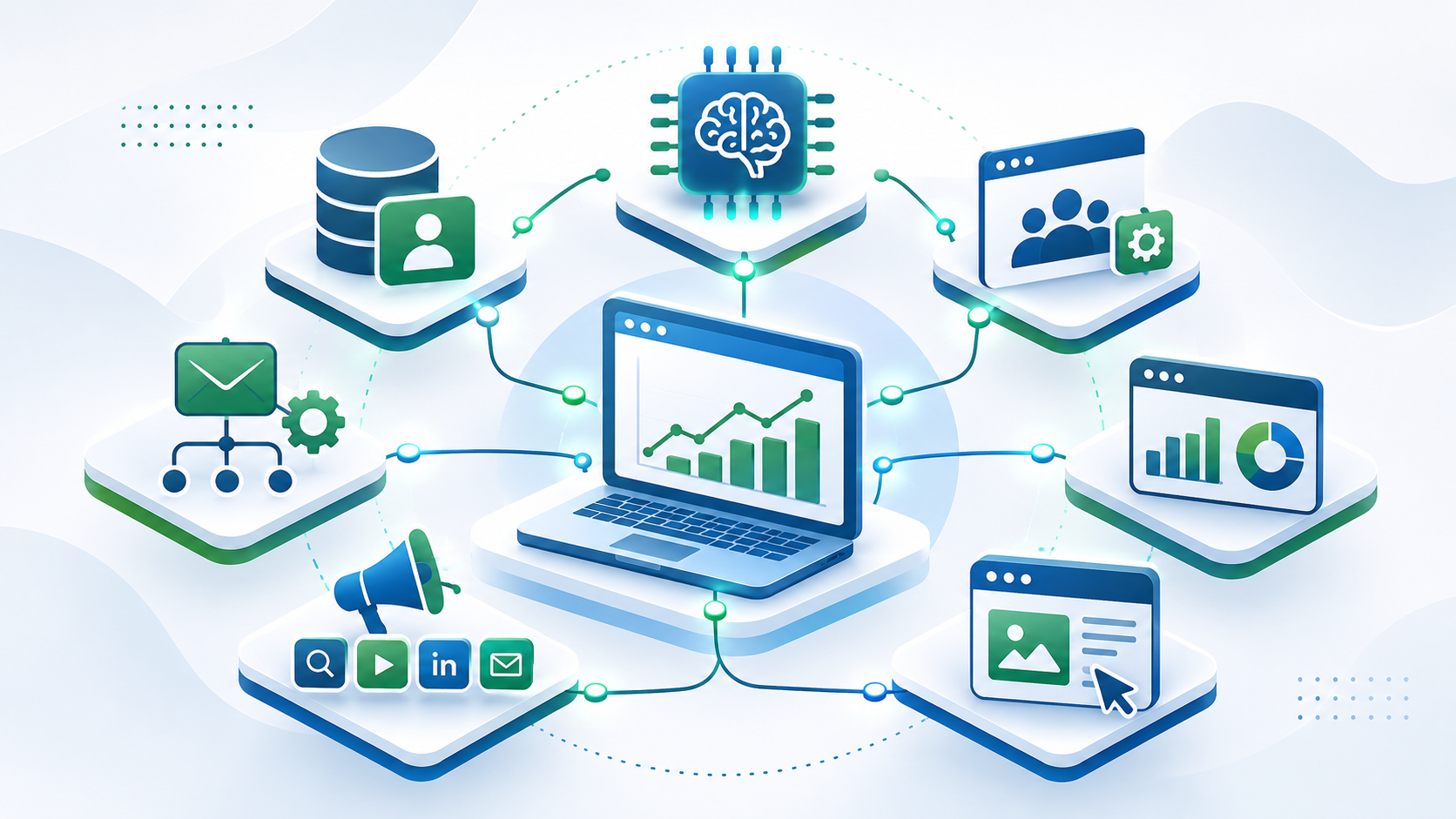
Still, a practical architecture can be organized into five layers.
The data foundation includes customer records, website interactions, campaign information, consent data and business intelligence sources.
Core marketing platforms include the website, CRM, marketing automation, advertising and analytics systems.
Integration and workflow orchestration use APIs, native integrations and automation tools to help different platforms exchange information and trigger actions.
AI and intelligence applications support research, content operations, analytics, personalization and workflow assistance.
Measurement and governance cover security, privacy, access controls, data quality and performance measurement.
The important thing is to avoid building an unnecessarily complicated architecture. A smaller organization may need only a website, CRM, marketing automation platform, analytics and a few well-planned integrations. A larger business may require a dedicated data warehouse, CDP and more advanced integration infrastructure.
The right stack is the one that supports the organization’s actual needs, not the one with the longest list of products.
6. How to build a modern MarTech stack: A practical roadmap
One mistake organizations make is trying to modernize everything at once. A better approach is to work in phases, starting with the areas that create the most operational friction.
Step 1 — Audit what you already have. Document every platform currently used by marketing and sales. Understand why each tool exists, who owns it, what it costs and whether it is being used effectively. Look for duplicate functionality, disconnected systems and manual processes.
Step 2 — Fix tracking and data quality. Review website tracking, campaign attribution, form submissions, CRM fields and reporting definitions. Make sure the business can reliably measure what matters.
Step 3 — Connect the essential platforms. Prioritize the website, CRM, marketing automation and analytics systems. Start with integrations that directly affect lead management, campaign measurement and customer experience. Test the data flow rather than assuming a connection works because it has been configured.
Step 4 — Automate repetitive workflows. Identify tasks that take up unnecessary time, such as lead routing, campaign notifications, report preparation, content approvals and data updates. Automate workflows where the process is already clear and predictable.
Step 5 — Introduce AI with a defined purpose. Choose a small number of use cases, such as AI-assisted research, campaign performance summaries or content operations. Measure whether the application saves time, improves quality or supports better decisions. Keep human review and appropriate data controls in place.
Step 6 — Review performance and improve. Review platform usage, integration reliability, campaign performance, lead quality and operational efficiency. As business requirements change, the architecture should evolve too.
7. Common mistakes that make MarTech investments less effective
Even organizations with substantial marketing technology budgets can struggle to get the expected return. A few mistakes appear repeatedly.
Buying technology before understanding the problem: A new platform may look impressive, but if the organization cannot clearly explain what problem it needs to solve, the investment is unlikely to deliver its full value.
Treating integration as an afterthought: Disconnected tools create disconnected processes. Integration requirements should be considered when selecting platforms, not after implementation.
Ignoring data quality: Automation and AI are only as useful as the information they receive. Inconsistent records and unreliable tracking undermine the entire ecosystem.
Automating broken processes: If lead ownership is unclear or approvals are poorly managed, automation will simply reproduce the same problems at a faster pace.
Measuring activity instead of business impact: Website traffic, email opens and campaign clicks are useful indicators, but they should be connected to qualified enquiries, opportunities and revenue wherever possible.
Adopting AI without governance: AI applications need appropriate data access, human oversight and clear accountability. Speed should not come at the expense of accuracy, privacy or trust.
8. What’s next: From connected tools to intelligent marketing operations
The next stage of MarTech will be shaped by how effectively organizations combine connected systems with AI.
AI agents are an emerging part of this evolution. Rather than simply generating content or answering questions, these systems can potentially carry out multi-step activities across connected applications.
For example, a research workflow might identify a topic, gather information, prepare a brief and send it for editorial review. A reporting assistant might collect campaign information, summarize changes and flag unusual results for a marketing manager.
These possibilities are promising, but they require a solid foundation. An AI agent cannot reliably coordinate a business process if the underlying systems contain inconsistent data, unclear permissions or poorly defined workflows.
This is why the next MarTech transformation is as much about operational design as it is about artificial intelligence.
The businesses that make progress will be those that understand their processes, connect their systems and introduce AI where it creates genuine value.
Conclusion: Build systems that make marketing work better
The modern MarTech stack is not about collecting the largest number of marketing tools. It is about creating a connected environment where customer information, campaigns, digital experiences, automation and analytics support one another.
AI is making this opportunity even more interesting. It gives marketing teams new ways to work with information, improve productivity and make more informed decisions.
But the fundamentals still matter: good data, reliable integrations, clear processes and meaningful measurement.
Before purchasing another platform or introducing another AI tool, take a closer look at the systems already in place. Are they connected? Are teams using the information effectively? Can marketing activity be linked to business outcomes?
Those questions are a much better starting point for building a modern MarTech ecosystem.
Better marketing starts with better systems.